


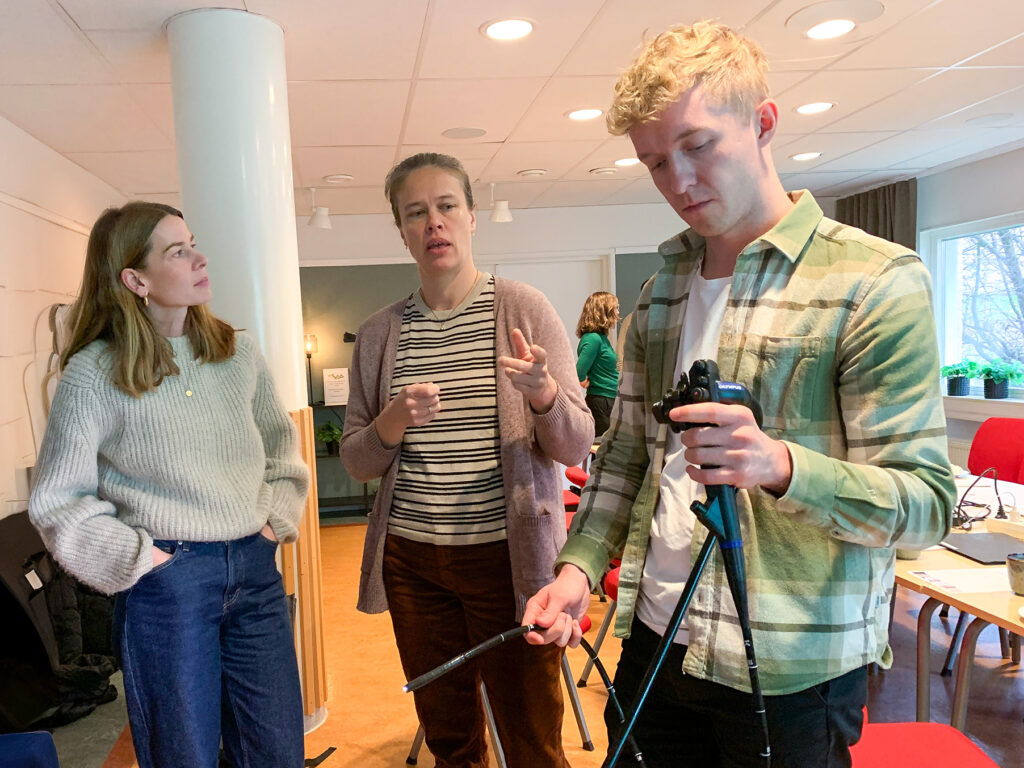
From right: Catherina Wilckens, Marie Bruun Nielsen, and Jonas Fredriksson
How can new workflows and equipment be ensured to work optimally in a clinical setting? In the SUSUES project, the answer is clear: by collaborating across professions, methods, and countries – and by taking users’ experiences into account.
Within the framework of the Interreg collaboration, Swedish and Danish partners work closely together to develop knowledge that can improve the use of single-use and reusable endoscopes, as well as the implementation of new workflows in endoscopy departments. Qualitative methods play a particularly central role in this work.
User Perspective in Change Processes
At Zealand University Hospital, Marie Bruun Nielsen is putting the finishing touches on a questionnaire guide. It will be used in her upcoming interviews with doctors and nurses, who in their daily work use either single-use or reusable endoscopes.
Marie works with qualitative methods to gain insight into the user perspective – that is, how healthcare staff experience the equipment and the associated workflows. This knowledge is crucial when changing practices in healthcare. “When equipment and workflows that affect staff’s daily work are potentially changed, it is essential to understand their experiences and what it means for their work and patient care,” Marie explains.
Some users handle the endoscope for long periods at a time, so it is crucial to identify any aspects of the equipment that do not work optimally in practice. This concerns not only job satisfaction and the working environment for healthcare staff, but also patient safety. Using an endoscope that does not function properly can affect patient treatment. This is precisely why it is important to involve users and gather their experiences in a project like SUSUES. The input provided, especially by nurses and doctors, offers valuable knowledge that can be used to further develop and improve endoscopy practices at the hospital.
Through clinical observations, Marie gains insight into how the endoscopes are used in practice. She has spent time in the operating theatre on multiple occasions, observing healthcare staff’s workflows during endoscopy procedures. These observations form the basis for interviews, in which doctors and nurses elaborate on their experiences. The combination of observation and interviews provides nuances that quantitative data alone cannot capture.
“You might initially think that a lighter single-use endoscope makes the work easier. But my interviews with surgeons show that the lower weight can also make the scope harder to control in certain situations. For some, it’s about missing a bit of weight; for others, it’s about habit. For me, it’s important to highlight these different perspectives,” Marie explains.
Interdisciplinary Collaboration Improves Quality
As part of the SUSUES project, Marie Bruun Nielsen works closely with Jonas Fredriksson, a PhD student at Norrlands University Hospital in Umeå, on user studies across Danish and Swedish endoscopy departments.
The collaboration has focused on creating a shared methodological framework for the qualitative studies, allowing insights to be compared and applied across national contexts. This brings together clinical experience, research expertise, and methodological knowledge.
The ongoing professional collaboration has helped strengthen the work on the user perspective and ensure a consistent approach to interviews and observations throughout the project.
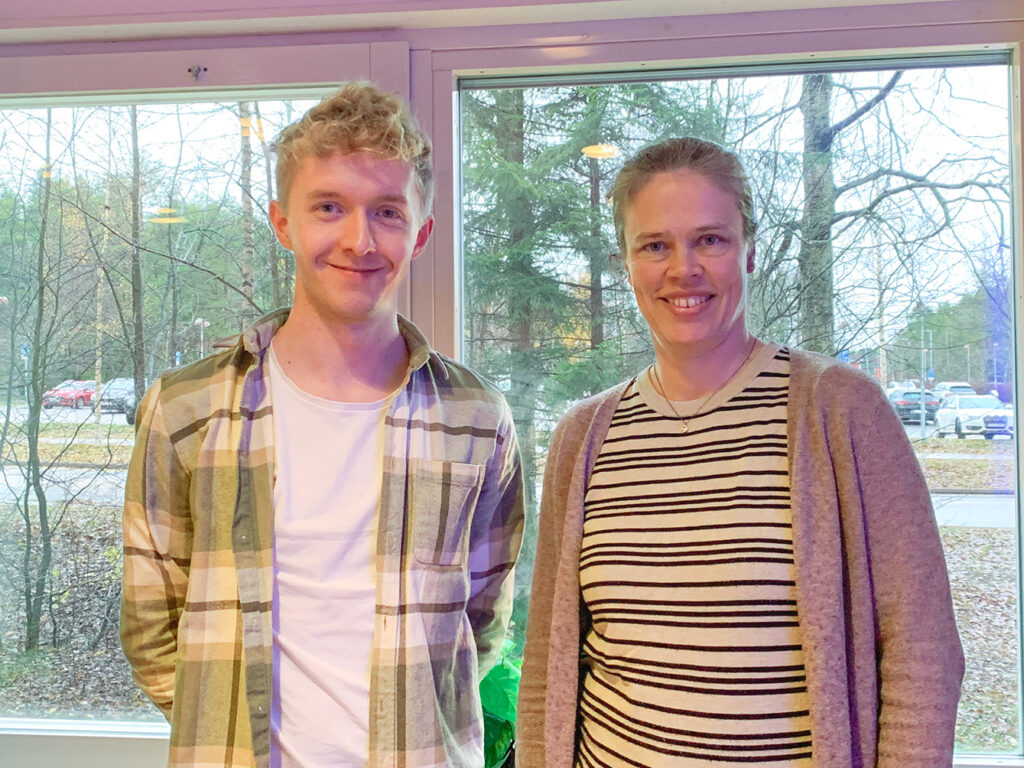
Jonas and Marie collaborate on user studies, each contributing their own professional expertise.
Gaining Practical Insights by Learning from Each Other
The collaboration was further strengthened during a project visit to Umeå, where Marie and Jonas spent time preparing for the upcoming interviews. Marie conducted an interview with a Swedish nurse, while Jonas observed.
“We discussed the interview afterwards; I explained, and he asked questions. This way, I try to pass on my knowledge and ensure that Jonas is prepared to conduct interviews.”
Subsequently, Jonas will conduct interviews with staff in the endoscopy department in Umeå to gain insight into the user perspective in the Swedish context.
Understanding Each Other’s Perspectives
Although endoscopy departments in Denmark and Sweden are similar in many ways, there are also local differences that can have a significant impact on the implementation of new workflows. For this reason, the SUSUES project places high priority on on-site visits, tours, and observations.
“Just being on a tour, having the opportunity to observe a procedure, standing in the corridor and simply watching, and conducting an interview has helped me understand the Swedish setup even better and appreciate the differences. Visits like these are invaluable!” says Marie.
Language differences can be challenging, but they can be overcome with openness and patience.
When Marie conducts interviews, she asks about things she has observed so that the participant has something to talk about, and she follows up with additional questions. This can make it challenging to interview someone who does not speak the same language – as Marie experienced during her visit to Umeå. “But it is possible, as long as both parties are not afraid to speak up when something is unclear. I think such an interview takes a bit longer, as both sides sometimes need extra time to explain what they mean,” Marie explains.
Qualitative Methods as a Tool for Implementation
In the SUSUES project, qualitative methods play a role alongside quantitative data. By observing and speaking with doctors and nurses, the project gains insight into how equipment and workflows are experienced in everyday practice. This provides concrete points on what works well – and where there may be challenges – to support the future use of endoscopes.
The collaboration between Marie and Jonas is a good example of how cross-regional and interdisciplinary cooperation works in practice within an Interreg project. Together, they exchange knowledge, provide feedback, and learn from each other – a way of working that adds value to the project and characterises cross-national collaboration under Interreg.
Read more